Natural selection is one of the basic mechanisms of evolution, along with mutation, migration, and genetic drift.
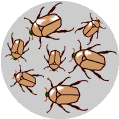
Darwin’s grand idea of evolution by natural selection is relatively simple but often misunderstood. To find out how it works, imagine a population of beetles:
There is variation in traits. For example, some beetles are green and some are brown.
There is differential reproduction.
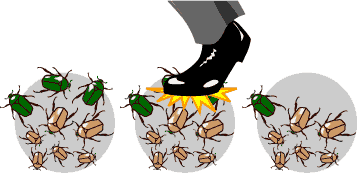
Since the environment can’t support unlimited population growth, not all individuals get to reproduce to their full potential. In this example, green beetles tend to get eaten by birds and survive to reproduce less often than brown beetles do.
There is heredity.
The surviving brown beetles have brown baby beetles because this trait has a genetic basis.
End result: The more advantageous trait, brown coloration, which allows the beetle to have more offspring, becomes more common in the population. If this process continues, eventually, all individuals in the population will be brown.
If you have variation, differential reproduction, and heredity, you will have evolution by natural selection as an outcome. It is as simple as that.
Mutation is a change in DNA, the hereditary material of life. An organism’s DNA affects how it looks, how it behaves, and its physiology—all aspects of its life. So a change in an organism’s DNA can cause changes in all aspects of its life.
Mutations are random.
Mutations can be beneficial, neutral, or harmful for the organism, but mutations do not “try” to supply what the organism “needs.” In this respect, mutations are random—whether a particular mutation happens or not is unrelated to how useful that mutation would be.
Not all mutations matter to evolution.
Since all cells in our body contain DNA, there are lots of places for mutations to occur; however, not all mutations matter for evolution. Somatic mutations occur in non-reproductive cells and won’t be passed onto offspring.
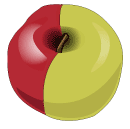
For example, the golden color on half of this Red Delicious apple was caused by a somatic mutation. The seeds of this apple do not carry the mutation.
The only mutations that matter to large-scale evolution are those that can be passed on to offspring. These occur in reproductive cells like eggs and sperm and are called germ line mutations.
A single germ line mutation can have a range of effects:
No change occurs in phenotype.
Some mutations don't have any noticeable effect on the phenotype of an organism. This can happen in many situations: perhaps the mutation occurs in a stretch of DNA with no function, or perhaps the mutation occurs in a protein-coding region, but ends up not affecting the amino acid sequence of the protein.
Small change occurs in phenotype.
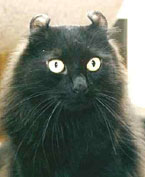
A single mutation caused this cat’s ears to curl backwards slightly.
Big change occurs in phenotype.
Some really important phenotypic changes, like DDT resistance in insects are sometimes caused by single mutations. A single mutation can also have strong negative effects for the organism. Mutations that cause the death of an organism are called lethals—and it doesn't get more negative than that.
There are some sorts of changes that a single mutation, or even a lot of mutations, could not cause. Neither mutations nor wishful thinking will make pigs have wings; only pop culture could have created Teenage Mutant Ninja Turtles—mutations could not have done it.
Genetic drift—along with natural selection, mutation, and migration—is one of the basic mechanisms of evolution.
In each generation, some individuals may, just by chance, leave behind a few more descendants (and genes, of course!) than other individuals. The genes of the next generation will be the genes of the “lucky” individuals, not necessarily the healthier or “better” individuals. That, in a nutshell, is genetic drift. It happens to ALL populations—there’s no avoiding the of chance.
Earlier we used this hypothetical cartoon. Genetic drift affects the genetic makeup of the population through an entirely random process. So although genetic drift is a mechanism of evolution, it doesn’t work to produce adaptations.
Genetic drift is the term biologists use to describe the gradual loss of certain genes from a species–genes that may have been very important for that species’ survival.
How Can Animals Lose Genes?
It’s kind of like reaching into a bag of M&Ms. If you take out a hundred M&Ms you are sure to get all the colors at least once.
If you only take out ten, you may well miss a color. And if by chance you haven’t missed a color, try it again. Very soon you will come up with, say, no reds.
Mixed Bag Of Genes
Every time an animal mates, its offspring receives a mixed bag of genes, half from its mother and half from its father. If the father and the mother share many of the same genes, their offspring will receive doubles of some of them.
The doubles don’t help, and they mean that some other gene that could have been passed on wasn’t. Think of the M&Ms. At the point where you failed to pull a red out of the bag, you have lost one gene. If your mate doesn't have that gene either, then your descendants will never have it. When Is Genetic Drift More Likely To Occur?
Low populations of animals means less genetic variation, which means genetic drift is more likely. If the gene that gets lost was critical to the survival of the species, they might begin dying off altogether.
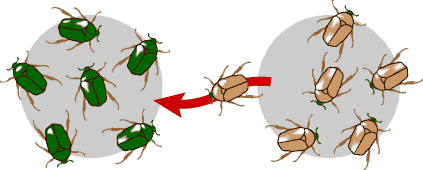
Gene flow—also called migration—is any movement of genes from one population to another. Gene flow includes lots of different kinds of events, such as pollen being blown to a new destination or people moving to new cities or countries. If genes are carried to a population where those genes previously did not exist, gene flow can be a very important source of genetic variation. In the graphic below, the gene for brown coloration moves from one population to another.
The amount of gene flow that goes on between populations varies a lot depending on the type of organism.
As you would expect, populations of relatively sedentary organisms are more isolated from one another than populations of very mobile organisms.
Lower rate of gene flow:
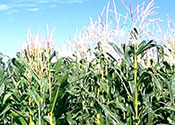
Corn, which is wind-pollinated, may be unlikely to fertilize individuals more than 50 feet away.1
Higher rate of gene flow:
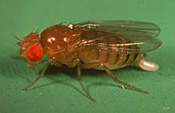
However, other organisms are able to distribute their genes much further. For example, fruit flies released in Death Valley were recaptured almost 15 kilometers away from the site of release.2
Gene flow has several important effects on evolution:
Within a population:
It can introduce or reintroduce genes to a population, increasing the genetic variation of that population.
Across populations:
By moving genes around, it can make distant populations genetically similar to one another, hence reducing the chance of speciation. The less gene flow between two populations, the more likely that two populations will evolve into two species.